|
The Life of Saint Bertram
Bertram was a King of
Mercia around the 8th century. (His life was written in the 1516 edition of
the Nova Legenda Angliae.) Thinking he might have a religious calling, he
traveled to Ireland where such saints as Patrick and Columba had lived. In
Ireland he fell in love and eloped with a beautiful princess. He brought her
back to Mercia traveling while she was pregnant. They lived a nomadic life,
and it is thought that the baby was born in the shelter of the forest near
Stafford. Tragedy occurred while Bertram was away hunting for food. Wolves
came and killed his wife and child.
Overcome with grief,
he renounced royal heritage and turned again to God. He sought a life of
prayer, and it is said that many pagans were converted to Christianity by
the example of his life.
Bertram approached the
court of Mercia but did not reveal his royal lineage. He asked for a grant
of land for the building of a hermitage. This land was granted near modern
day Stafford. Historians record the name of the hermitage as Bethnei.
A New King took
throne. Not being a religious man, he demanded back the land on which the
hermitage stood. It was decided that the matter should be settled by man to
man combat. Bertram prayed for someone to come forward to fight for the
hermitage. A man who was a dwarf came forward and Bertram remembering the
David and Goliath accepted his offer. The dwarf was agile and quick and the
hermitage kept its land.
Bertram is also linked
to the village of Bartomley near Audley in present day Cheshire. It is said
that Bertram, having dedicated his life to Christ, was sought out by the
devil who tempted him to turn stones into bread. Bertram prayed rather that
the bread would be turned to stones. In 1516 it was said that those stones
were still in the church at Bartomely.
Bertram was known in
the area as a wise and holy man. Many sought him out for spiritual advice.
As seen throughout the history, holy men and women beset by people
constantly and needing to refresh their souls seek solitude in quiet
unpopulated places. Bertram found a cave near the present day sight of Ilam
in Derbyshire. He lived there until his death.
Back to top ...
|
|
2004 Pilgrimage to St. Bertram's Shrine at Ilam |
|
We were joined again by priests from Derby, Nottingham, Chesterfield and
Levenshulme, Louth; and Deacon Ian from Nottingham with some of their
congregations.
Archpriest Daniel Joseph from Derby was Protos and Fr.Samuel
blessed water from St Bertram's Well, which was fetched from the spring
high up on the hill before the Liturgy by Terence.
The remains of
two Saxon crosses are to be found in the churchyard.
For a life of St. Bertram -
click here.
|
|
|
|
|
| |
|
|
|
|
|
| |
|
|
|
|
|
| |
Back to top ...
|
|
Pilgrimage to Lucca
In May of 2003 I went with
Jean, my wife, on a pilgrimage to Lucca in Tuscany. Our purpose was to
discover what we could of Saint Richard, King of the West Saxons, for he is
my Name Saint in Orthodoxy.
We flew to Pisa, where we
spent three days, and then took a train to Lucca, about twenty five minutes
away. This is a beautiful medieval city, surrounded by walls - about 4 km in
circumference. It has narrow streets, large open squares and a multitude of
churches. It is by and large traffic free, but everywhere is within walking
distance - even for people of our age!
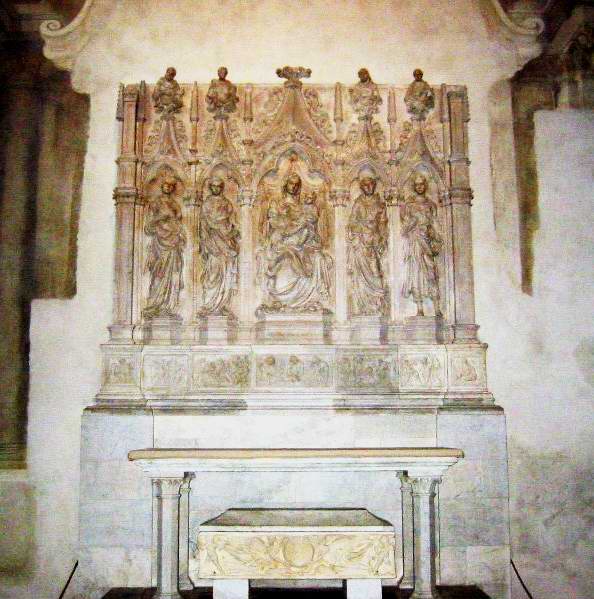
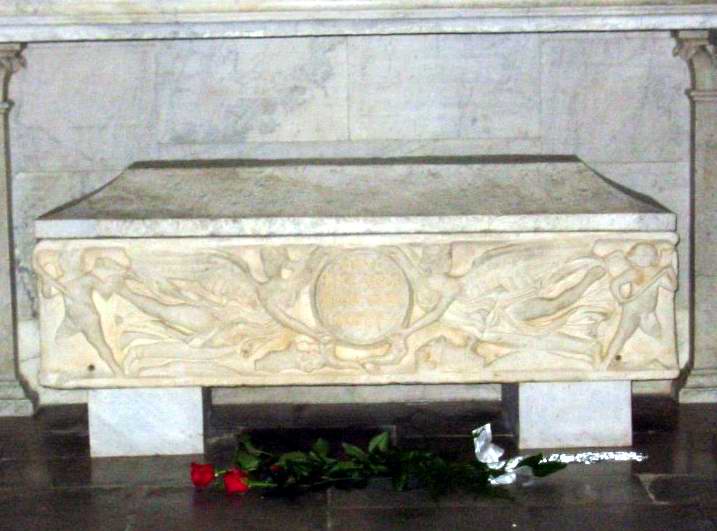
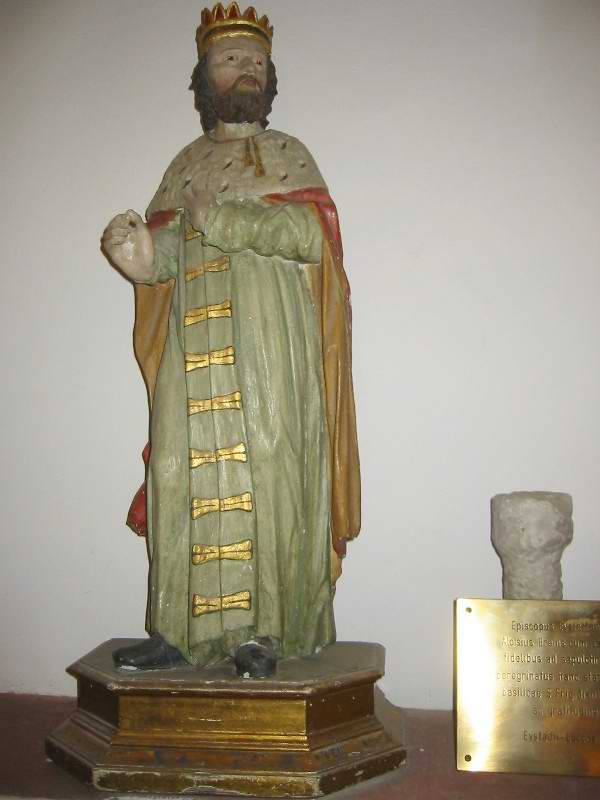
We found in the church of
Saint Frediano that there is not only a chapel dedicated to Saint Richard,
but that his relics were kept in a sarcophagus under the altar in this
chapel. This was better news than we had expected, and it would have been
more wonderful indeed if only we had not arrived at a time when the chapel
was being renovated and restored. There was scaffolding and an abundance of
plastic sheeting, and, inside the chapel, a litter of paint pots, scrapers
and other tools.
But we were determined
souls and we hadn't come all this way on pilgrimage to be put off so easily.
We dragged aside some of the plastic sheeting, thrust in a camera, and took
a photograph. Then we intoned the Trisagion prayer and sang a troparion to
Saint Richard. We felt at least that our pilgrimage had not been in vain.
We discovered that his
feast day was kept in Lucca on 7th February, as it is at home; and in the
church bookshop we found cards and icons, and even a booklet of more than 60
pages. This had been written by a priest of the parish in 1947 and had been
reprinted in 1977 because of the great interest shown in Saint Richard. The
drawback here was that the booklet was in Italian - and there was no English
translation. Nothing daunted, we bought a copy, brought it home and bought
an Italian dictionary; and although neither of us speaks Italian I have set
about translating it. It is a truly fascinating book, as I hope you will
agree when you have read it, as I am sure you will want to!
Although there were
drawbacks over the chapel and Saint Richard's tomb, there is certainly the
incentive to go back again when the work has been completed.
Richard Grace
Back to top ...
|
|