|
November 2008
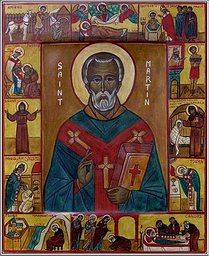
In this Issue
St
Martin
How to Make Kolyva
|
How well do you know your Saint?
St Martin of Tours
I have
had the name Martin from an early age! I
have never really liked it and as a
youngster thought how nice it would be
to change it – maybe to Steve or Dave
something more up to date. I found by
reading through the lectionary during
sermons at Coventry, that St Martin’s
Day was celebrated on 11th November –
the day after my birthday. I asked Mum
about this but she said it must be
coincidence because she hadn’t chosen
the name by reference to any prayer
books.
 So when my Chrismation was afoot, there
arose the possibility of changing my
name. A number of alternatives appealed
– Zacchius sounded fun since he was a
short man and a bit of a comedy
character in my book. Then I thought
about Martin again and did a little bit
of reading about him – particularly the
story about the cloak.
So when my Chrismation was afoot, there
arose the possibility of changing my
name. A number of alternatives appealed
– Zacchius sounded fun since he was a
short man and a bit of a comedy
character in my book. Then I thought
about Martin again and did a little bit
of reading about him – particularly the
story about the cloak.
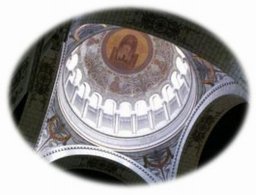
St
Martin seen in mosaic above the
Sanctuary in the Basilica St Martin in
Tours
Giving just half his cloak to a beggar
seemed to ring bells with me – that’s my
sort of generosity: to give a bit of
something but not leave yourself
without! I might manage to emulate this
sort of thing – and that is of course
part of the point of a Name Saint; to
have someone to try to emulate or model
oneself on.
So I stuck with the name Martin after all those years
of wanting to change it.
I was lucky enough to have the opportunity, with
Carolyn, to take a pilgrimage to Tours
in France where St Martin was Bishop,
before attending the enthronement of
Metropolitan John. Now I know more about
St Martin, his life and times, I realise
there was rather more to him than
half-hearted generosity. After all, how
could I have thought that one can become
a saint simply by giving away half a
cloak? There had to be more to it than
that...
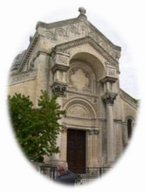
St Martin’s Rebuilt Basilica in Tours
Born in 316 in Savaria, Martin’s Father was a senior
officer in the Roman army and Martin
grew up in Ticinum in modern Pavia,
Italy. At aged ten, he went to church
against his parents wishes and became a
catechumen. At this time, Christianity
had only just become a legal religion
but was still a minor faith, with the
cult of Mithras being by far the
dominant religion in the army. When aged
15, Martin was required to join the
cavalry himself and was stationed in
what is now Amiens in France.
It was while serving as a soldier that he impulsively
gave half his cloak to a beggar. That
night he received a vision of Christ
wearing that cloak which Martin had
given away, saying to the angels: “Here
is Martin, the Roman soldier who is not
baptised; he has clothed me.”
 So Martin was baptised and refused to
battle with the Gauls at Worms in 336
saying “I am a soldier of Christ. I
cannot fight.” Charged with cowardice,
Martin’s response was to volunteer to go
to the front of the troops unarmed. It
was planned to accept this offer but
peace broke out, the battle never
happened and Martin was released from
military service.
So Martin was baptised and refused to
battle with the Gauls at Worms in 336
saying “I am a soldier of Christ. I
cannot fight.” Charged with cowardice,
Martin’s response was to volunteer to go
to the front of the troops unarmed. It
was planned to accept this offer but
peace broke out, the battle never
happened and Martin was released from
military service.
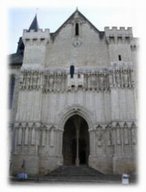
The church at Candes where Martin died
Martin then became a disciple of Hilary
of Poitiers, a chief opponent of
Arianism and proponent of
Trinitarianism. When Hilary was forced
into exile, Martin returned to Italy to
lead the life of a hermit on the little
island of Gallinaria. When Hilary
returned in 361, Martin joined him again
and Hilary gave Martin a wilderness
retreat. Many people came to see him and
enough stayed as disciples that Hilary
founded a monastery for them called
 Legug
where Martin lived until Hilary died. It
was here that Martin performed one of
his first and many miracles. When a
catechumen died before baptism, Martin
laid himself over the body and after
several hours, the man came back to
life. Legug
where Martin lived until Hilary died. It
was here that Martin performed one of
his first and many miracles. When a
catechumen died before baptism, Martin
laid himself over the body and after
several hours, the man came back to
life.
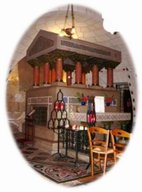
The tomb of St Martin beneath the Altar
in the Basilica
In 371, Martin became the reluctant Bishop of Tours –
hiding from the people in a barn full of
geese. The geese made such a noise that
his hiding place was given away – so he
is the Patron Saint of Geese! Martin
lived not in a palace, but in a cell
attached to a church in the hope of
maintaining the lifestyle of a monk, but
the role of Bishop meant that people
came constantly to Martin with questions
and concerns that involved all the
affairs of the area.
To regain some solitude, Martin withdrew outside the
city to a cabin made of branches. Here
he attracted as many as eighty disciples
who wanted to follow him and so he
established a monastery at Marmoutier
near Poitiers which still survives today
and is the longest operating monastery
in France – and somewhere to visit on my
next trip.
It is easy to suppose that Martin avoided many of his
bishoping responsibilities, but he was
said to be very committed to his people.
One of these responsibilities was, he
felt, to convert those who still held to
non-Christian beliefs. He did not
attempt to convert these people by
preaching from a high pulpit or from far
away, but instead he travelled from
house to house speaking to people about
God. He would then organise the converts
into a community under the direction of
a priest or monk. He would visit these
communities regularly. Of course, he
sometimes ran into resistance. On one
occasion he tried to convince locals to
cut down an old pine tree they
venerated. They agreed, but only if
Martin would sit directly under the the
path of the leaning tree. Martin sat
himself down by the tree and the
townsfolk began to cut away at the other
side. Just as the tree began to fall,
Martin made the sign of the cross and
immediately the tree fell in the
opposite direction – slowly enough to
miss the fleeing people. He made many
converts that day!
The wondrous stories of Martin and his miracles are
worthy of a book in their own right –
indeed his biographer Sulpicius Severus
(c363 – 420) wrote lengthy works, begun
before Martin’s death. There is too much
to repeat in this small space.
 Martin died in Candes and although
accounts differ as to the year (between
395 and 402) it was known to be on
November 8th. Monks from Tours came and
stole his body during the night from the
monks in Candes, and he was buried, at
his request, in the Cemetery of the Poor
in Tours.
Martin died in Candes and although
accounts differ as to the year (between
395 and 402) it was known to be on
November 8th. Monks from Tours came and
stole his body during the night from the
monks in Candes, and he was buried, at
his request, in the Cemetery of the Poor
in Tours.
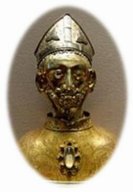
The reliquery for the head of St Martin
from the late 14th Century – now in the
Louvre
Martin’s successor as Bishop in Tours, Bricius, built a
little chapel over Martin’s grave and
then when Bishop Perpetuus took office
in 461 a grand basilica was built as the
chapel was no longer sufficient for the
crowds of pilgrims that were already
coming. Martin was reburied behind the
altar of the basilica, his sarcophagus
placed on a large block of marble to
make it visible. The basilica itself was
160ft long and 60ft wide and contained
120 columns.
Destroyed many times by fire, the basilica was rebuilt
beginning in 1014 and the shrine became
a major stopping point on pilgrimages.
The basilica was finally sacked by the
Huguenots in 1562, then it was
deconsecrated during the French
Revolution, used as a stable and then
its dressed stones sold and a street
built on the site.
In 1860, excavations established the dimensions of the
former basilica and a project for a new
basilica took shape in 1871. The present
building was consecrated in 1925 and
maintains the shrine of St Martin in the
same position as the original basilica,
containing a small reliquery and all
that remains of the relics of St Martin.
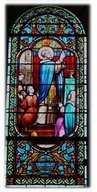 The story of St Martin is everywhere in
this part of France – from depictions in
stained glass windows, frescoes and
carvings to beautiful paintings – and
societies throughout the world concerned
with charity and justice for the poor
and oppressed are dedicated to St
Martin.
The story of St Martin is everywhere in
this part of France – from depictions in
stained glass windows, frescoes and
carvings to beautiful paintings – and
societies throughout the world concerned
with charity and justice for the poor
and oppressed are dedicated to St
Martin.
Martin offers up the Host at the Liturgy
Aside from miracles, the introduction of the Chenin
Blanc grape and the technique of pruning
vines is attributed to St Martin – so he
is also the Patron of wine growers, wine
makers and (curiously) reformed
alcoholics. He is also Patron Saint of
the Pontifical Swiss Guards, the diocese
of Rottenburg-Stuttgart and Buenos
Aires. Martin Luther was named after him
as he was baptised on St Martin’s day in
1483.
As the Advent Fast draws near, it is also interesting
to note that from the late 4th century
until the late Middle Ages, much of
Western Europe – including Great Britain
– engaged in a period of fasting
beginning on the day after St Martin’s
Day. The fast lasted 40 days and was
therefore called “Quadragesima Sancti
Martini”. At St Martin’s Eve and on the
feast day, people ate and drank heartily
– the traditional food being, of course,
goose. This fasting time became Advent.
So St Martin is a much more worthy Saint than I had
first imagined – and not as
straightforward to emulate as I had
hoped.
I have a considerable way to go!
Martin Shorthose
|