A Week in Cambridge
A very abridged account of the IOCS
Summerschool entitled “The Ascent to
Holiness”
My week in Cambridge was never
meant to make a Holy person out of
me – it will take more than a course
with the Institute for Orthodox
Christian Studies to do that!
Instead it was a week of lectures,
most by eminent speakers, on the
subject of “Holiness” – what is it,
how is it acquired, how does it show
itself and so on.
My week was spent at Sidney
Sussex College with a variety of
other students from very diverse
backgrounds – Orthodox (from
Antiochian, American, Russian and
Greek jurisdictions), and a variety
of other Christians and some not. In
all there must have been about 40 of
us.
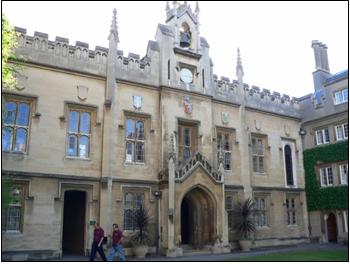 My tiny room at the college,
while not having enough space in the
bathroom to swing even a small shrew
was comfortable and provided lovely
views across the “Masters Garden”
over to the tower of St. John’s.
My tiny room at the college,
while not having enough space in the
bathroom to swing even a small shrew
was comfortable and provided lovely
views across the “Masters Garden”
over to the tower of St. John’s.
Sidney
Sussex College
So what is Holiness?
Dr. George Bebawi spoke twice
during the course of the week, both
times with much humour and frequent
digressions from his script. His
first lecture was on “Discernment”
and at an early stage in his
presentation he warned us against
any “method” being applied to
discernment and the search for
holiness.
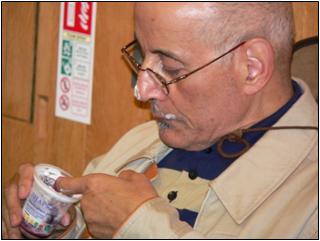
Dr Bebawi
enjoys a spot of lunch – yes, it is
yoghurt and not face cream!
 “Christian life is not controlled
by methods or guided by techniques.
We have a fellowship with the
persons of the divine and Holy
Trinity,” he told us. So, to
participate in the life of God
denies for us a method or a
technique. We cannot be part of the
life of a person – any person – by
learning a method or a technique”.
“Christian life is not controlled
by methods or guided by techniques.
We have a fellowship with the
persons of the divine and Holy
Trinity,” he told us. So, to
participate in the life of God
denies for us a method or a
technique. We cannot be part of the
life of a person – any person – by
learning a method or a technique”.
But he also warned against what
he described as “learning wisdom”.
He quoted from the Egyptian Desert
Father, Abba Poemen, who said: “A
man who teaches without doing what
he teaches is like a spring which
cleanses and gives drinks to
everyone, but is not able to purify
itself.”
He told us the story of a monk in
Egypt who wanted to be martyr. His
abbot warned him against false
heroism and told him it was easy to
be unusual. True heroism, the abbot
said, is found in daily life,
looking for reality and finding
God’s will there.
The monk persisted in his quest
for martyrdom however, and headed
off to an area controlled by nomadic
tribes, and demanded to become a
martyr. But once they captured him,
he was unable to resist, and rather
than accept the pain of martyrdom he
worshipped their idols.
He returned to the monastery,
tearing his robe, where the abbot
reminded him that true heroism often
lies in dealing with daily realities
rather than seeking to be dramatic
or unusual.
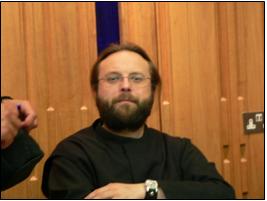
The speaker Revd Dr Nikolai
Sakharov looked at “Holiness in the
Old and New Testaments.” He traced
the movement from early ideas that
saw holiness as the holiness of God,
whose holiness was linked to being
separate from the world; through
later
 ideas
about the physical dimensions of
holiness, including the holiness of
inanimate objects set aside for the
worship of God, the holiness of
people who were set aside for
worship and who were expected to be
ritually pure, or the holiness of
soldiers, prophets and Israel as a
nation, before moving on the concept
of the holiness of people being
found in spiritual holiness.
ideas
about the physical dimensions of
holiness, including the holiness of
inanimate objects set aside for the
worship of God, the holiness of
people who were set aside for
worship and who were expected to be
ritually pure, or the holiness of
soldiers, prophets and Israel as a
nation, before moving on the concept
of the holiness of people being
found in spiritual holiness.
Revd Dr Nikolai Sakharov
However, in the New Testament,
holiness comes not so much with
separation, but with living the word
and following Christ in loving
others. “For us Orthodox Christians,
to love is not just to be nice,” he
said. “To love is no longer an
ethical or moral category, but an
ontological category.”
(I had to look this up too – so I
will save you the trouble! Ontology
– the study of
being or
existence)
And he added: “Christ is our
living commandment. How otherwise
can you teach people to love? There
is no other way aside from example”.
In the afternoon Fr Andrew Louth
spoke about “The Holy Man in Late
Antiquity”.
In an insightful paper, he looked
at the difference between the saint
and the martyr, between the holy man
and the saint, between the holy man
and the wise woman, and the between
holy man and the holy place.
I certainly left the lecture room
that evening with my brain fizzing
and wondering if there was enough
room for a whole week of similar
talks!
One highlight of the week – only
marred by the coach leaving
Cambridge at 6:00am – was our visit
to the Monastery of St John the
Baptist in Tolleshunt Knights where
we attended the Divine Liturgy.
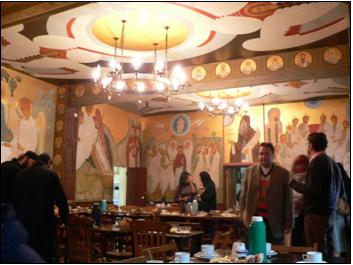
Breakfast in the wonderfully painted
refectory
 I had to wonder if the church
might have been better fitted with
pews as there were all manner of
stools and chairs brought along by
the congregation for their comfort!
I had to wonder if the church
might have been better fitted with
pews as there were all manner of
stools and chairs brought along by
the congregation for their comfort!
We then breakfasted with the
Monks and Nuns – enjoying excellent
homemade bread, preserves and much
welcome coffee before settling in
the Silhouan Room for an inspired
talk by Sister Magdalen on “Monastic
Holiness” and “Monastic
Spirituality.”
For her, “Holiness is the divine
life lived in human life, made
possible in the incarnation, which
shows us it is possible to live as
the sons or daughters of God.”
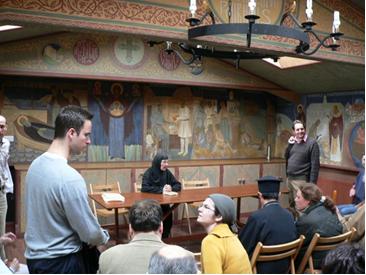 Sister
Magdalen in the Silhouan Room
Sister
Magdalen in the Silhouan Room
In the monastic life, she
explained simply, if you love Christ
then you do his will. If you are
irritated by the habits or behaviour
of another member of the community,
you do not get angry or complain,
but pray in words such as: “Lord,
have mercy on Sister Magdalen and by
her holy prayers have mercy on me.”
If I
will take anything with me from this
week – and I have much to take –
then these words will be the ones
which I hope I can put into
practice.
After a wonderful lunch with the
community, we enjoyed the peace and
quiet of the monastery for an hour
or so before returning for Vespers
at the college.
Singers were quickly volunteered
from our party on the very first
evening to form a choir under the
direction of the wife of our
Chaplain Fr Raphael, Carolyn. We
sang Vespers each evening and Matins
every morning at 7:30am. If anyone
thinks this was a holiday, then
please think again! 7:30am to me is
no holiday!
Musically, the toughest thing to
get the hang of was the curious
notation for Troparia and Kontakia
known locally as “chicken bones”.
This identifies where the tune goes
– but it is up to the other parts to
fit their harmonies in accordingly.
It is a sort of hybrid Byzantine
notation which was – and largely
still is – a bit of a mystery to the
uninitiated.
Wednesday saw Dr George Bebawi
back on the stand for a talk on
“Holiness in the Eastern and Western
Churches” – the lecture which was of
most interest to my wife, Carolyn
(an Anglican) who asked me to take
notes. Dr George spent little time
in discussion of the topic however
but there were some really inspired
words of wisdom in what he offered
and some great digressions into
stories of his fascinating and
eventful life. “Holiness is not a
virtue,” he told us, “but is a
participation in the holiness of
God, period.” Humility, silence and
asceticism are virtues in the
practice of holiness, he explained;
but holiness is a participation in
God’s holiness. To be
holy is to receive or to participate
in the holiness of God. When we
receive Holy Communion, we receive
and participate in the holiness of
Christ. But we cannot
acquire holiness. We
can
protect holiness by
asceticism, but we cannot acquire
holiness.
To stay in the realm of grace
requires practice. But grace is
received, not achieved.
Christ is the head of the body,
which is the Church, and every
member of the body participates in
the holiness of Christ. Holiness, in
its definition, is deification; it
is not a virtue, but is the work of
the Holy Spirit within us.
Every human being is made in the
image of God. And so, if holiness
means being dedicated to God, then
in every person there is a glimpse
of God.
Later, Professor Sebastian Brock
spoke on “Holiness in Song: St
Ephrem the Syrian.” Saint Ephrem
wrote most of his theology, at the
height of the Arian controversy, as
poetry. He wrote of the interior
liturgy of the heart which is
required as a response to the
outward liturgy of the Church, and
spoke of the three churches that
need each other and need to function
together - the heavenly church with
the heavenly liturgy; the church of
the altar and the liturgy on earth;
and the church of the human heart
with its interior liturgy.
The afternoon didn’t see Dr
Christine Mangala at the lectern as
billed, as she had been unavoidably
delayed in Syria. Her husband
Professor Frost read her lecture
instead. Coming from a Hindu
background and a family of Brahmen
poets, she is ideally experienced to
talk on “Holiness in Eastern
Religion: an Orthodox Perspective.”
Dr Mangala described so-called
holy men on the banks of the Ganges
with their ascetic practices, many
of them extreme cases with fakirs,
swamis, and gurus engaging in
self-torture, growing lengthy nails
and beards, standing on one leg, or
lying on beds of nails.
She asked “Can there be saints in
non-Christian religions? Can there
be manifestation of the Holy Spirit
in other religions? And how should
Christians respond to them?”
She offered by way of response
that she had found true holiness in
the everyday life of ordinary
Hindus, expressed in their everyday
lives, their music, their poetry and
even in their dance. The search for
the love and grace of a personal God
are deeply rooted in the Hindu
psyche, and in their poetry
especially we can find a longing for
the divine, the holy, the pure.
Father Samuel preached one Sunday
early in my journey to St Michael’s
that we cannot know where God is,
and in whose soul he chooses to
lodge.
We sing in the Beatitudes
“Blessed are the poor in Spirit –
for theirs is the Kingdom of
Heaven”. It was ventured that some
of these religions might fall into
this category but that a glimpse of
something Christian can often be
seen in them.
We sing “Blessed are the pure in
heart – for they shall see God” and
this certainly encompasses many
believers in many religions who in
their devotion put me to shame,
although when they meet God, they
may be a little surprised.
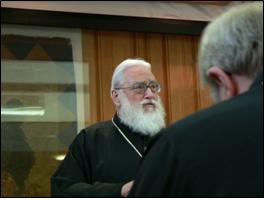 Metropolitan Kallistos arrived
and sat opposite me for lunch – a
charming and witty man indeed whose
lecture on “What is a Saint?” did
not disappoint.
Metropolitan Kallistos arrived
and sat opposite me for lunch – a
charming and witty man indeed whose
lecture on “What is a Saint?” did
not disappoint.
Metropolitan Kallistos
He described the moment in the
Divine Liturgy when the Priest says
“The Holy Things are for the Holy,”
which he pointed out could also be
translated as: “The sacraments for
the saints,” or: “The holy things
for the saints.”
There is one, he said, who is
holy - Jesus Christ. Sanctity
belongs to God, and we merely
participate in God’s holiness. “But
sanctity is a universal vocation, to
be a saint is the norm; a saint is a
normal human being, as God intended
humanity to be. All the baptised are
called to be saints.”
The saints are intensely alive,
and living in and with the living
Christ, he said. “They share the
mind of Christ and hear our
prayers.”
He added “The saints are
surprising. It is sin that is
monotonous. Sanctity is surprising.
There are no new sins, but always
new forms of sanctity … Saints
express the uniqueness of our human
vocation.”
Later, Archimandrite Ephrem Lash,
who has been a regular lecturer at
the institute in Cambridge, spoke
about the Liturgy in his paper,
“Sober Drunkenness: Holiness in the
Liturgy.”
There was little by explanation to
follow.
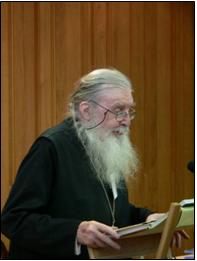 He said that he had been given
the title on which to talk and while
he agreed to using the title, the
content would bear no relation!
He said that he had been given
the title on which to talk and while
he agreed to using the title, the
content would bear no relation!
I learned much about the Liturgy
in this lecture which I had not
considered before.
Archimandrite Ephrem Lash
To sum up his talk however, he
said the Liturgy is a communal act,
not private devotions. “We do not go
to church to pray as individuals, we
go to make a joyful noise unto God.”
Everything about the Liturgy is
holy, and the object of the liturgy
is to make us partakers of God’s
holiness, to have communion. The
gifts are made holy by the work of
the Trinity, where the Holy Spirit
is the agent of the Holy Trinity.
The Epiklesis or invocation of the
Holy Spirit is not a magic moment,
but about hallowing or making holy.
He said again that the purpose of
the Liturgy is not to produce the
“real presence”, but is communion,
with the holy gifts transformed into
the Body and Blood of Christ so that
we may eat and drink them.
And so drew to a close what had
been a wonderful week.
We enjoyed a celebration meal
together and then a small group of
us retired to “The Mitre” pub where
we drank “The Reverend James’ Ale”.
This couple of hours summed up
the spirit of the week – one
Orthodox Priest, and Anglican Woman
Priest, a Lutheran from Iceland and
a Church of Ireland Priest and me,
discussing not only the lectures of
the day but talking about our own
experiences. All over a refreshing
couple of drinks.
As closing time approached, we
adjourned to the cloisters of the
college where we sat for a further
two hours drinking Cockburns Port –
kindly supplied by our Icelandic
friend!
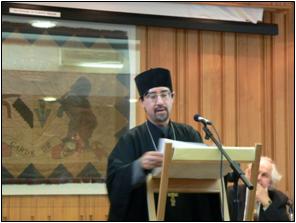 Father
Alexander Tefft from our sister
Father
Alexander Tefft from our sister
Antiochian Parish in London sums up
the week before retiring to The
Mitre
As Father Patrick (who as you
might guess was the aforementioned
Church of Ireland Priest) so aptly
asked – “Were we indulging in sober
drunkenness or was it drunken
sobriety? We may not have been holy
fools, but we certainly had what
came close to “magic moments” or
even communion with one another this
past week.”
Martin Shorthose – with thanks to
Father Patrick who made far more
notes than I did and had the
foresight to take down the quotes.
|
If you have any items for
the newsletter, please
e-mail Simon Harvey at
simon.harvey@stoke.gov.uk
or else leave a copy of your
submission with Father
Samuel or with Simon at
church. Ideally, submissions
should be made by the 15th
of the month to get into the
following month’s edition.
Exceptions may be made in
emergencies. |
 Saturday
16th August
Saturday
16th August